


What does a Wedding Celebrant Do?

Updated: Nov 4

The short answer is almost everything. Well, everything ceremony-related, anyway.
Most people only see a celebrant standing in front of a couple for 20 or 30 minutes, delivering a ceremony, saying a few pretty words and making everything official. What they don't see is everything that happens before, during and after those few minutes.
And here's the thing. Not every couple wants the same wedding, so not every wedding requires the same amount of work.
There are as many different kinds of celebrants as there are couples planning to marry, so out there somewhere is the perfect one for you.

A Wedding Celebrant does all your legal paperwork.
Australian marriage celebrants are authorised to handle the legal requirements of getting married without you having to deal directly with government departments.
We help you complete and lodge your Notice of Intended Marriage (NOIM), check your identification, make sure you're legally free to marry and establish that you're both consenting freely.
We prepare all the necessary documents, ensure the compulsory legal words are said during the ceremony, supervise the signing of the marriage certificates and register your marriage afterwards.
But if we seem a little picky about names, dates, identification and signatures, there's a reason for it. Getting married is a legal process and getting the details right matters.
Whether you want five minutes around my kitchen table or a spectacular wedding with 150 guests, the legal requirements are essentially the same.

A Wedding Celebrant works with you.
One of the biggest skills a celebrant can have is effective listening. You can't create a wonderful wedding experience if you have a set way of doing things and expect every couple to fit your mould.
And something I've noticed more and more lately is that couples often tell me what they DON'T want before they can explain what they do.
No walking down the aisle. No bridesmaids. No long speeches. No being the centre of attention for half an hour. That's absolutely fine. My job is to help you work out what you actually want and how we can make that happen.
Not every wedding involves the same amount of work.
We don't all spend weeks writing elaborate love stories for every couple we marry.
If you simply want to be legally married, there's very little ceremony preparation involved. We'll meet to organise the paperwork, then get together again with your two witnesses and say the compulsory words. It's over in about five minutes.
A micro wedding or elopement style ceremony needs a bit more. There's a ceremony to prepare, personal vows and perhaps a ring exchange. I use a short questionnaire to get a feel for the couple. There's preparation and usually some tweaking involved, but nobody needs to spend hours telling me their entire life story.
Then there are the fully bespoke weddings, where I prefer spending time talking with my couples rather than relying entirely on detailed questionnaires. I want to understand what makes you tick, what matters to you and how you communicate.
I use a lot of big words and fancy grammar IRL (and cop a bit of stick from the extended family about it), but if you don't, you're not gonna want a ceremony full of complicated wording that sounds completely foreign to you and your guests.
Writing a ceremony from scratch is only part of it. There are meetings, revisions, decisions about music and other elements, rehearsals where needed, and all the little practical details involved in bringing everything together.
We might have a dozen conversations about things you'd never previously considered, or you might leave most of the decisions to me.
Neither approach is better. It's about creating the experience that's right for you.

A Wedding Celebrant Sets the Tone.
The ceremony is where the magic starts. It IS NOT the boring bit you have to suffer through before the party.
But that doesn't mean it has to be long.
If you want five minutes to get married over lunch at the pub, fabulous. If you want a room full of people laughing, crying and cheering as you make your promises to each other, we can do that too. What matters is that the experience is right for you.
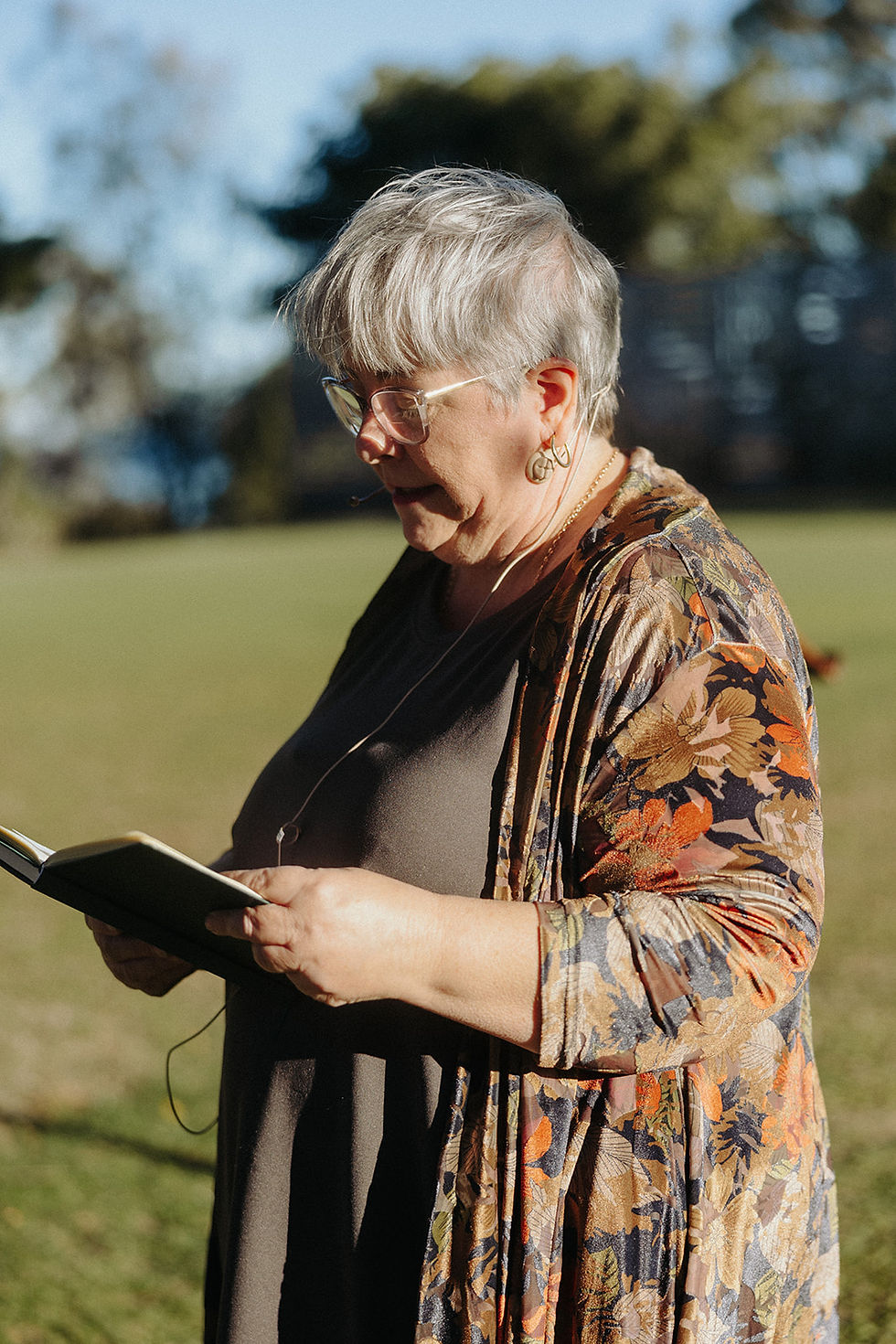
And delivering a ceremony involves more than reading the words. There's making sure everyone knows where to stand, helping nervous couples relax, coordinating the important moments and dealing with whatever unexpected things happen along the way.
On the day I'll be checking that everything is ready, that the music and sound are sorted (if we're using them), that the important people know what they're doing and that the ceremony can flow naturally without you having to worry about any of it.
Being able to think on your feet, keep everyone comfortable and make it look effortless is a pretty important part of the job.
What does a celebrant do after the wedding?
I don't disappear the moment I've pronounced you married, either. I always hang around for a while afterwards, making sure everything is wrapped up and lending a hand if the photographer needs help wrangling people into group photos. Getting 40 excited guests to stop hugging each other and look at the camera is quite an undertaking sometimes.
And while you're heading off for photos (or straight to the bar), there's still the legal paperwork to finish. The signed marriage documents must be submitted for registration, and arrangements made for your official marriage certificate.
Then it's on to the next couple, whose wedding might be entirely different from yours.
That's one of the things I love about this job.
Ready to find your celebrant?
Brisbane celebrants are a close and supportive community. If we meet and discover we're not quite on the same wavelength (highly unlikely!), I can probably recommend a colleague who'll be perfect for you.
The important thing is finding someone who understands what you want your wedding to feel like and has the experience to make it happen.
[Explore my wedding packages] and see which version of "I Do" feels right for you.


Comments